Saturday, October 8, 2011

Jesus the Suffering Conqueror

Because of Jesus’ resurrection, all threats against you are tamed if you trust in Christ. Jesus conquered death, so death and evil done to you is not the end of the story and you can have hope. In the book of Revelation, one of the key themes is conquering through suffering. This theme is evident in the number of the occurrences of the verb “to conquer” in the book. John describes amazing promises to Christians, addressing the promises specifically to those who “conquer”:
-To the one who conquers I will grant to eat of the tree of life, which is in the paradise of God. (2:7)
-The one who conquers will not be hurt by the second death. (2:11)
-To the one who conquers I will give some of the hidden manna, and I will give him a white stone, with a new name written on the stone that no one knows except the one who receives it. (2:17)
-The one who conquers and who keeps My word until the end, to him I will give authority over the nations. (2:26)
-the one who conquers will be clothed thus in white garments, and I will never blot his name out of the book of life. I will confess his name before My Father and before His angels. (3:5)
-The one who conquers, I will make him a pillar in the temple of My God. Never shall he go out of it, and I will write on him the name of My God, and the name of the city of My God, the new Jerusalem, which comes down from My God out of heaven, and My own new name. (3:12)
-The one who conquers, I will grant him to sit with Me on My throne, as I also conquered and sat down with My father on His throne. (3:21)

How will these staggering promises come to pass? How will they conquer amid affliction and persecution? How will they find the strength to endure and overcome against all odds? John provides the answer: they will conquer by looking by faith to the One who has already conquered, Jesus Christ. We read in Revelation 5:5-6:
    And one of the elders said to me, “Weep no more; behold, the Lion of the tribe of Judah, the Root of David, has conquered, so that he can open the scroll and its seven seals.”
    And between the throne and the four living creatures and among the elders I saw a Lamb standing, as though it had been slain
John describes Jesus as the kingly Lion and the meek Lamb who has conquered all of His and our enemies. Jesus has conquered His enemies through His suffering and death on the cross, and yet he is also one who has been slaughtered. Jesus is “the faithful witness, the firstborn of the dead, and the ruler of kings on earth,” and He is the one “who loves us and has freed us from our sins by His blood and made us a kingdom of priests to His God and Father.” We reign with Him because He died and freed us and made us a kingdom for His glory.

Justin & Lindsey Holcomb, Rid of My Disgrace: Hope and Healing for Victims of Sexual Assault, Crossway Publishers, 2011, pg. 147-148

Saturday, October 1, 2011

Peace I leave with you; My peace I give to you. Not as the world gives do I give to you. Let not your hearts be troubled, neither let them be afraid. (John 14:27)


Peace is Jesus’ bequest to His disciples. Peace was commonly used at this time as a word of greeting (20:19, 21, 26) or of farewell. It thus comes in aptly in this final discourse of our Lord’s. But the expression used here is not the usual formula of farewell; Jesus is using the term in His own way for His own purposes. The repetition of “peace” is impressive. The concept is important. Having stated positively what He gives, Jesus goes on to differentiate this give from anything that the world can give. When the world uses “peace” in a greeting it expresses a hope. It can do no more. And even that it usually does in no more than a conventional sense like our “good-bye” (= “God be with you”). But Christ effectually gives His people peace. Moreover, the peace of which He speaks is not dependent on outward circumstances, as any peace the world can give must necessarily be. Because He gives people such a peace Jesus can enjoin them not to be troubled in heart no cowardly. A Christ given serenity excludes both. In the Bible “peace” is given a wider and deeper meaning than in other Greek writings. For the Greeks (and for us) peace was essentially negative, the absence of war. But for the Hebrews it means positive blessings, especially a right relationship with God. This is to be seen in the Old Testament and is carried over into the New. The word here has its fullest content. 

Leon Morris, The Gospel According to John, New International Commentary on the New Testament, Eerdmans, 1995, pg. 583-584

Monday, September 26, 2011

My hope


You're my hope for tomorrow
My peace for today
You're the joy in my sorrow
the Truth and the Way


-Jimmy Robeson, 2007

Sunday, September 25, 2011


Sorrowing I shall be in spirit,
Till released from flesh and sin,
Yet from what I do inherit,
Here Thy praises I’ll begin;


Robert Robinson, A Col­lect­ion of Hymns Used by the Church of Christ in Angel Al­ley, Bi­shop­gate, 1759.

Friday, September 23, 2011

Thrilling!


"When I enter the pulpit with the Bible in my hands and in my heart my blood begins to flow and my eyes to sparkle for the sheer glory of having God's word to expound."

John Stott, as quoted by Roger Steer in Basic Christian; The Inside Story of John Stott, IVP Press, 2009

Thursday, September 22, 2011

Why Does Jesus Identify With Us?


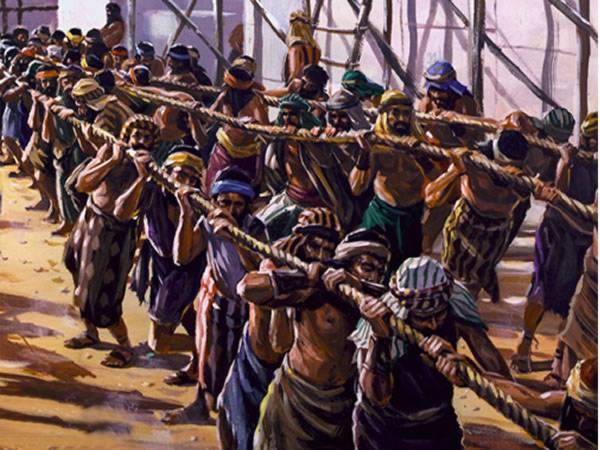
Moses, like Jesus, was not ashamed to consider His people who were in slavery as His brothers, and He was prepared to identify with them in order to deliver them. (Exodus 2:11, 4:18, Hebrews 11:24-26).
Peter O’Brien, The Letter to the Hebrews, Apollos Press, 2010 page 118

Saturday, September 10, 2011

He changes everything

 
Ever good thing we could think or desire is to be found in this same Jesus Christ alone, For,
He was sold, to buy us back;
captive, to deliver us;
condemned, to absolve us;
He was made a curse for our blessing,
sin offering for our righteousness,
marred that we might be made fair;
He died for our life;
so that by Him
fury is made gentle,
wrath appeased,
darkness turned to light,
fear reassured,
disposal despised,
debt cancelled,
labour lightened,
sadness made merry,
misfortune made fortunate,
difficulty easy,
disorder ordered,
division united,
ignominy ennobled,
rebellion subjected,
intimidation intimidated,
ambush uncovered,
assaults assailed,
force forced back,
combat combated,
war warred against,
vengeance avenged,
torment tormented,
damnation damned,
the abyss sunk into the abyss,
hell transfixed,
death dead,
mortality made immortal.
In short, mercy has swallowed up all misery, and goodness all misfortune. For all these things which were to be the weapons of the devil in his battle against us, and the sting of death to pierce us, are turned for us into exercises which we can turn to our profit. If we are able to boast with the apostle, saying, ‘O hell, where is thy victory? O death, where is thy sting?’ it is because by the Spirit of Christ, we live no longer, but Christ lives in us.

John Calvin, as quoted by Justin & Lindsey Holcomb, Rid of My Disgrace: Hope and Healing for Victims of Sexual Assault, Crossway Publishers, 2011, pg. 101

Sunday, September 4, 2011

Jesus Leads Many Sons To Glory


The goal of His marvelous purpose is to ‘bring many sons (and daughters) to glory.’ In the Old Testament the theme of the Lord’s leading His people is familiar, particularly Israel’s exodus from Egypt (Exodus 3:8, 6:6-7, 7:4-5, etc) where God’s mighty action is underscored. As the elect people of Yahweh, Israel knew from the beginning of it’s history that the Lord was its ‘Leader’. 
For the author of Hebrews the typological significance of God leading His people out of Egypt is obvious. Language that describes this event is deliberately employed by our author to describe God’s action of leading many contemporary sons and daughters to glory. It is cast in terms of a new exodus with believers as ‘the new Exodus generation’.
Peter O’Brien, The Letter to the Hebrews, Apollos Press, Nottingham, Pg. 104

Saturday, September 3, 2011

Talitha Cumi


“Banishing all from the house except the parents and His three chosen disciples, He entered the chamber of death to rob it of its prey.” 
- Henry Ironside commenting on Mark 5:40

Friday, September 2, 2011

Who is qualified to recieve God's grace?


God receives none but those who are forsaken, restores health to none but those who are sick, gives sight to none but the blind, and life to none but the dead...He has mercy on none but the wretched and gives grace to none but those who are in disgrace.

Martin Luther, as quoted by Justin & Lindsey Holcomb, Rid of My Disgrace: Hope and Healing for Victims of Sexual Assault, Crossway Publishers, 2011, pg. 17

Saturday, August 27, 2011

Jesus is a merciful and faithful High Priest.


He is a faithful as well as a merciful high priest in God’s service. It is possible, of course, to suggest here that in His high priestly service Christ is merciful towards man and faithful to God, the twin title reflecting the manward and Godward aspects of His ministry. 
But it is equally true that He is faithful to us. The trustworthy and reliable Christ is the One who comes to our help when we are tempted, not a vacillating, capricious, occasionally unavailable Helper, but One who has proved Himself fully dependable and completely adequate in every experience of life.
 
Raymond Brown, The Message of Hebrews, Bible Speaks Today, IVP, 1982 pg. 72

Thursday, August 11, 2011

Three Terrible Questions and One Astounding Answer


Alas and did my Saviour bleed and did my Sovereign die?
Would He devote that sacred head for such a worm as I?
Was it for crimes that I had done He groaned upon that tree?
Amazing pity, grace unknown and love beyond degree!

Wednesday, August 10, 2011

A long gestation period before the new birth


God's reward for faithful ministry is beautifully illustrated by the story of Luke Short, converted at the tender age of 103. Mr Short was sitting under a hedge in Virginia when he happened to remember a sermon he had once heard preached by the famous Puritan John Flavel. As he recalled the sermon, he asked God to forgive his sins right then and there, through the death and resurrection of Jesus Christ. Short lived for three more years, and when he died, the following words were inscribed on his tombstone, 
"Here lies a babe in grace, aged three years, who died according to nature, aged 106."

Here is the truly remarkable part of the story. The sermon that old Mr. Short remembered had been preached eighty-five years earlier back in England! nearly a century passed between Flavel's sermon and Short's conversion, between the sowing and the reaping. Sooner or later, by the grace of God, faithful work always has it's reward.


Philip Ryken, Entrusted with the Gospel, Crossway Publishing, 2010 page 41


Let us not grow weary of doing good, for in due season we will reap, if we do not give up.
Galatians 6:9

Monday, August 1, 2011

Prayer Requested / Be för mig snälla


Today I am leaving with Rachel, Eoin and Aan-Sofie to the Calvary Chapel Scandinavian Conference in Stockholm. I'll be teaching two of the main sessions;
Thursday night I'll be talking about legalism as the chief enemy of the gospel from 1 Timothy 4, 
and Saturday morning I'll be talking about the work of gospel ministry from 2 Timothy 2.
I hope that I can encourage (and be encouraged by) my Swedish, Norwegian, Finnish and Icelandic brothers and sisters. Your prayers are appreciated.  
Tack så mycket!


O cross, tool of salvation of the Most High! 
O cross, banner of Christ’s victory over all enemies!
St Andrew