Saturday, July 16, 2011

Why Does God Love Us?


He is the great God, “the God of the spirits and of all flesh,” “the high and lofty One that inhabiteth eternity,” and created not angels and men because He wanted them, for He is being itself, and as such must necessarily be infinitely happy in the glorious perfections of His nature from everlasting to everlasting; and as He did not create, so neither did He redeem because He needed us, but He loved us because He loved us, He would have mercy because He would have mercy, He would show compassion because He would show compassion.

Susanna Wesley (1669-1724) as quoted by Fred Sanders in The Deep Things of God: How the Trinity Changes Everything, Crossway Publishers, 2010, pg. 67

What translation do you use?

A conversation between myself and Shane Angland about Bible Translations. (5 of 6, more to come!) 

Thursday, July 14, 2011

Is the Bible historically reliable?

A conversation between myself and Shane Angland about the Historical Reliability of the Bible. (3 of 6, more to come!)


Monday, July 11, 2011

Textual Criticism

A conversation between myself and Shane Angland about Textual Criticism. (2 of 6, more to come!)


Saturday, July 9, 2011

The Canon of Scripture

A conversation between myself and Shane Angland about the Canon of Scripture. (1 of 6, more to come!)

Friday, July 8, 2011

Jesus is Better

In this epistle... Everything presented is presented as better:
a better hope, 
a better covenant, 
a better promise, 
a better sacrifice, 
a better substance, 
a better country, 
a better resurrection, 
a better everything. 
Jesus Christ is presented here as the Supreme Best.
And we are presented as being in Him and as dwelling in a completely new dimension – the heavenlies.
We read of the heavenly Christ, 
the heavenly calling, 
the heavenly gift, 
the heavenly country, 
the heavenly Jerusalem, 
and of our names being written in the heavenlies.
Everything is new. Everything is better. We don’t need the old.

-John MacArthur, commenting on the Epistle to the Hebrews

Thursday, June 30, 2011

Apart from Him...

The Christian’s life in all its aspects - intellectual and ethical, devotional and relational, upsurging in worship and outgoing in witness - is supernatural; only the Spirit can initiate and sustain it. So apart from Him, not only will there be no lively believers and no lively congregations, there will be no believers, and no congregation at all.

J.I. Packer, quoted by Francis Chan, Forgotten God, David C. Cook Publishers, 2009, pg. 83

Wednesday, June 29, 2011

How does God reveal Himself?


...When it comes to the great, defining events of the economy of salvation, it has been God’s direct intention to do these things in order to make Himself known to us.
In the old covenant, the central events were the choosing of Abraham, the Exodus from Egypt, and the gift of the Promised Land. In these events God was doing something in history that brought about knowledge of Him. “I will take you to be My people, and I will be your God,” He declares in Exodus 6:7, with the result that “you shall know that I am the LORD your God, who has brought you out from under the Egyptians.” At the other end of Old Testament history, the Lord promises that He will bring His people back from exile and that this mighty act will result in sure knowledge of His identity and character: “And I will put My Spirit within you, and you shall live, and I will place you in your own land. Then you shall know that I am the LORD; I have spoken, and I will do it, declares the LORD (Ezek 37:14). Over and over, God links accurate knowledge of His character to recognition of a definite constellation of His mighty acts on behalf of His people.
But those old-covenant events all cry out for their divinely ordained fulfillment in the new covenant, where God completes His intention to make Himself known.  The book of Hebrews begins by announcing this breakthrough to a new level of God’s self expression toward us: “Long ago, at many times and in many ways, God spoke to our fathers by the prophets, but in these last days He spoke to us by His Son” (Heb 1:1-2). This Son is not simply a messenger who carries God’s words, or an interpreter who explains God’s ways. He is “the radiance of the glory of God and the exact imprint of His nature” (v.3), and His being sent into the world is itself a mighty act of God to simultaneously save us and reveal Himself. 

-Fred Sanders, The Deep Things of God: How the Trinity Changes Everything, Crossway Publishers, 2010, pg. 131

Saturday, June 25, 2011

How has God spoken to us through His Son?


The revelation from Jesus Himself was unique, because not only was it purely God's message (as was the case with every other inspired writer) but it was also God's personality through which the message came. the personality of Paul, Peter, John and the other Biblical writers is clear in their writings. yet in the revelation from Jesus we see the personality of God.

David Guzik commenting on Hebrews 1:2 "In these last days He has spoken to us by His Son" 
Hebrews, Enduring Word Commentary Series, pg 12, 2004


Thursday, June 23, 2011

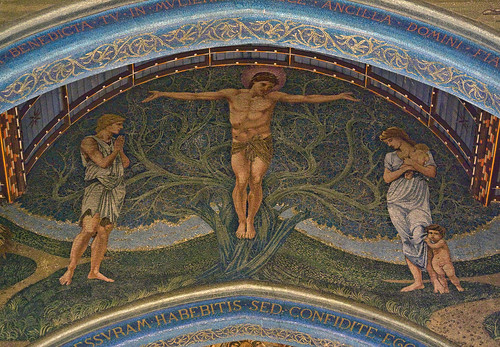
Two Trees


For, as death came upon the human race by the disobedience of one man, it was fitting that by another man’s obedience life should be restored. And, as sin, the cause of our condemnation, had its origin from a woman, so ought the author of our righteousness and salvation to be born of a woman. And so also it was proper that the devil, who, being man’s tempter, had conquered him in eating of the tree, should be vanquished by man in the suffering of the tree which man bore. Many other things also, if we carefully explain them, give a certain indescribable beauty to our redemption as thus procured.

Anslem of Canterbury
Cur Deus Homo

Where does the bride of Christ come from?


 Because of the sin of the first Adam, society sinks deeper into the mire of sin and guilt. But thank God, there’s another Adam - a Second Adam - God’s Son. God provided a bride for that first Adam - Eve was created from a rib that God took out of Adam’s side when he was in a deep sleep.
 
 Likewise God also has provided a bride for the second Adam. We are that bride. And in order to get His bride, Christ’s side was also pierced - it was pierced as He hung there upon the cross at Golgotha. But there was no deep sleep for Him. There was no anesthesia. Even a mild form of vinegar and gall was refused by Christ, that He might experience the pain that sin properly deserves. This pain is something we must endure forever if He does not endure it for us.

-D. James Kennedy, 
Cross Purposes, 
Multnomah Publishers, 2007, pg. 62.

Wednesday, June 22, 2011

What is the goal of the church?


Missions is not the ultimate goal of the church. 


Worship is. 


Missions exists because worship doesn't. 

Worship is ultimate, not missions, because God is ultimate not man. When this age is over, and the countless millions of the redeemed fall on their faces before the throne of God, missions will be no more. It is a temporary necessity. But worship abides forever. 

John Piper, 
Let the Nations be Glad; the Supremacy of God in Missions, Baker Academic, 2003,  Page 17